Windsurf · Funboard revolution
1982
A childhood board breaks the Windsurfer patent
In a case against the world's biggest board maker, an English court accepts Peter Chilvers' 1958 board as prior art; the patent that ruled the industry starts to crumble.
Prior art
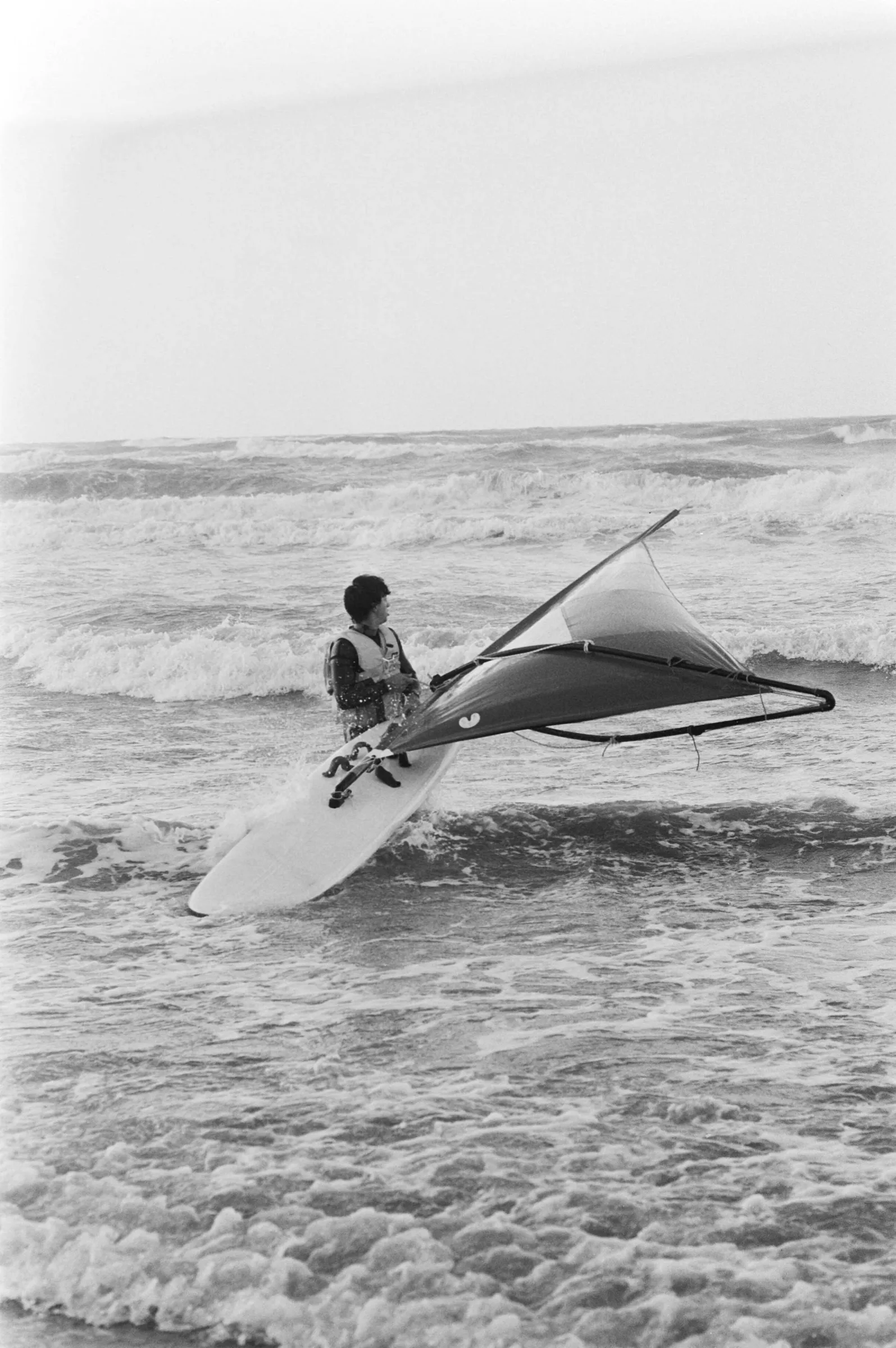
Peter Chilvers' home-made board of 1958, accepted by an English court against the Windsurfer patent
Hoyle Schweitzer held the Windsurfer patent in the United States, West Germany, the United Kingdom, Canada, Australia and Japan, and defended it hard. Licensed makers paid seven per cent of their trade price; Windsurfing International reportedly won some forty suits in Germany alone.
In 1982 it took on the largest producer in the world, Tabur Marine, owned by the French plastics group BiC, for selling boards in the United Kingdom without a licence. Tabur’s lawyers found Peter Chilvers, who as a boy in 1958 had sailed a home-made board with a hand-held rig. The court accepted his board as prior art, and on 31 January 1984 the Court of Appeal confirmed that the British patent was revoked. Elsewhere, Newman Darby’s 1964 sailboard was used as prior art in the same way.
Other cases followed, often backed by BiC. Uncertainty and legal costs weighed on the whole industry until the US patent finally ran out in 1987.
Marcel Antonisse / Anefo · Nationaal Archief · CC0